
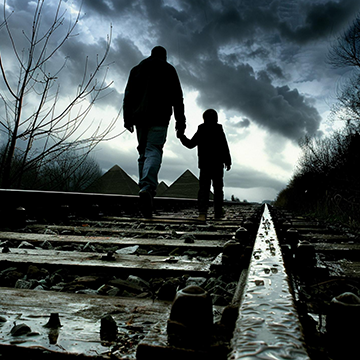
Fathers, Sons, and the Damage Power Leaves Behind
Power doesn’t just crown kings. It scars them.
In Heavy Is the Head: The Ring of the Prophet, Brennan G. Leggett doesn’t treat power as a prize to be won or a throne to be claimed. Instead, power is something inherited like a wound. It passes from parent to child, often unexamined, carrying cruelty, fear, and silence along with it. At the heart of the story is King Benecio, a man trapped between what he was given and what he refuses to become.
This is not just a story about war or magic. It’s about fathers and sons. This story explores the consequences that arise when authority replaces love and when survival breeds cruelty more quickly than compassion.
The Father Who Ruled Through Fear
Benecio’s father looms over the story even after death. He ruled with control, discipline, and punishment. Strength was expected. Weakness was not tolerated. Love, if it existed at all, was conditional.
That kind of upbringing leaves a mark. Benecio didn’t inherit his father’s throne alone. He inherited the belief that leadership requires emotional distance, that softness is dangerous, and that showing fear invites destruction. His father didn’t just shape the kingdom. He shaped how Benecio understands himself.
This is how toxic legacy works. It rarely announces itself as abuse. Instead, it dresses itself up as “preparation,” “discipline,” or “duty.” Children raised under harsh authority often grow into adults who don’t know how to rest, trust, or ask for help. Benecio carries this everywhere, even when he’s trying to lead differently.
Becoming the Man You Swore You Wouldn’t Be
One of the most painful moments in the book isn’t a battle or a betrayal. It’s Benecio realizing that under enough pressure, he starts thinking like his father.
He didn’t want to rule through fear. He didn’t want to harden his heart. He wanted to be better.
However, war doesn’t care about your intentions.
As Marcella’s invasion escalates and the kingdom begins to fracture, Benecio is forced to make impossible choices. Every decision risks lives. Every hesitation risks collapse. Slowly, subtly, the same instincts his father relied on begin to surface: control, isolation, emotional shutdown.
This is where the story becomes deeply relatable. Many people know what it feels like to say, “I’ll never be like them,” only to hear the same words leave their own mouth years later. Trauma doesn’t repeat itself loudly. It repeats itself quietly, under stress, when survival feels more urgent than healing.
The Ring as Inherited Damage
The Ring of the Prophet is not just a magical artifact. It is a metaphor for generational harm.
It grants power, but it takes something in return. It whispers. It tempts. It feeds on fear and control. The more it is used, the more it erodes the wearer’s humanity. That mirrors how inherited trauma works. You gain tools to survive, but you lose pieces of yourself along the way.
Benecio did not choose the ring. It was placed on his hand as part of his birthright. Just as he did not choose the ruthless king’s expectations, silence, or emotional distance, he also didn’t choose the ring. The ring represents everything passed down without consent, everything labeled “legacy” that feels more like a curse.
Breaking the Cycle Is the Hardest Battle
What makes Heavy Is the Head powerful is that it doesn’t pretend that breaking the cycle is easy or heroic.
Benecio doesn’t magically overcome his upbringing. He struggles. He shuts people out. He withholds the truth. He makes choices driven by fear of becoming his father rather than faith in himself. Even his love for his siblings and his wife is shaped by a need to protect them from the darkness he believes lives inside him.
Yet, the story leaves room for something rare: intentional change.
Benecio questions the ring. He questions his instincts. He invites his siblings into the truth instead of carrying it alone. These moments matter. They show that breaking generational damage isn’t about being perfect. It’s about pausing long enough to choose differently, even when it hurts.
Why This Story Hits Home
This book resonates because it recognizes a fundamental truth: power frequently harms before it empowers. Families carry on more than just titles and traditions. They pass on concerns, coping strategies, and hidden norms about love and worth.
Benecio’s story is not just about a king facing invasion. It is about a son trying to survive the shadow of a father who taught him that strength meant silence. It is about realizing that inheriting power is easy. Choosing to wield it requires avoiding cruelty.
Heavy Is the Head serves as a reminder that the most perilous legacies are not magical rings or royal bloodlines. They are the ones we hold within us, taught early, reinforced frequently, and challenged far too late.
In addition, sometimes, the bravest thing a leader, a parent, or a child can do is look at what they were given and say:
This ends with me.